
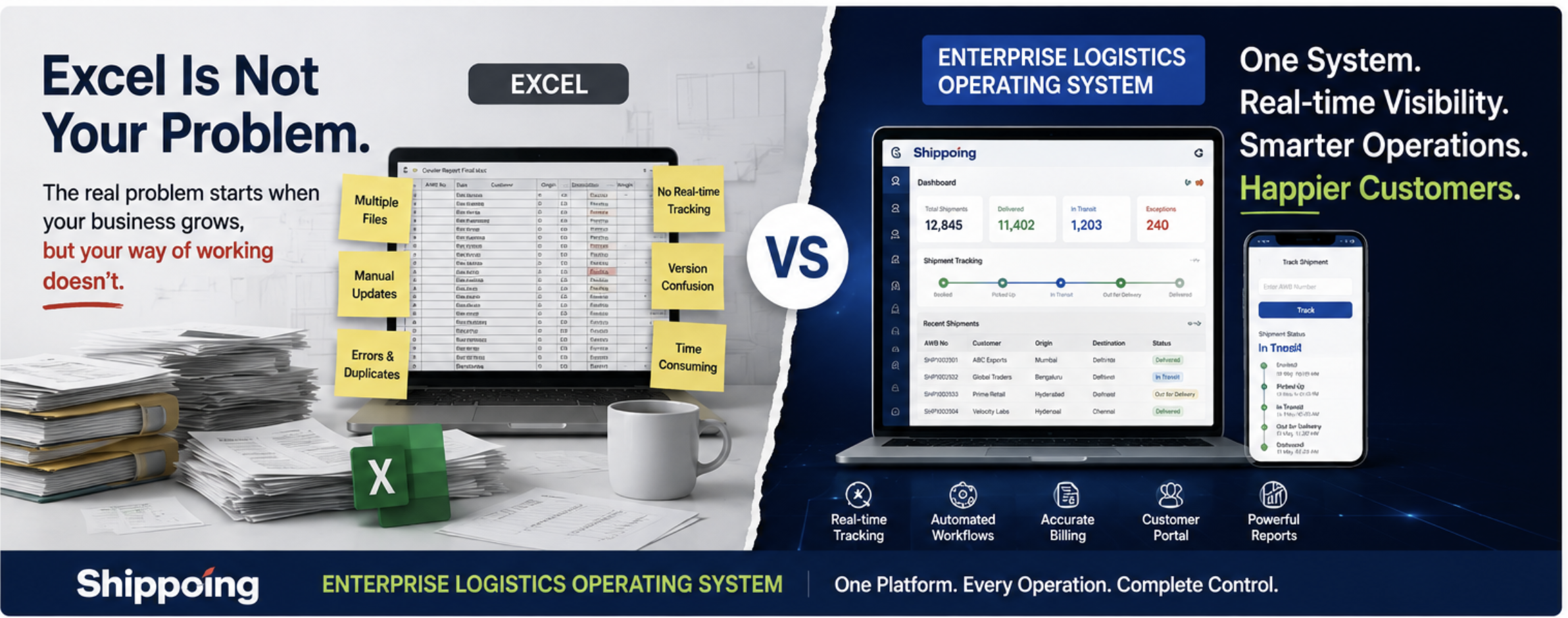
The real problem starts when your business grows, but your way of working doesn’t.
By Shamshularphin Ansari | Founder, Shippoing
From disconnected spreadsheets and manual follow-ups to one connected logistics operation.
I am going to say something unusual for someone who provides courier management software.
Don’t replace Excel.
At least, not just because somebody tells you that spreadsheets are outdated.
If Excel is working for your courier business, your team is comfortable with it, customers are getting timely shipment updates, billing is accurate, POD is under control, and management gets the information it needs, keep using it.
Seriously. Excel is an excellent tool.
The problem starts somewhere else. It starts when your business grows—but your way of working doesn’t.
It Usually Happens Quietly
You start with one spreadsheet. It contains everything: shipments, customers, rates, delivery status—maybe even billing.
Then the business grows. Accounts creates another sheet for billing. Operations creates its own shipment sheet. Customer service starts maintaining another one because they need shipment status. Someone starts maintaining POD separately. One branch creates its own format. Another branch changes that format slightly.
And then the filenames begin:
- Courier Report Final.xlsx
- Courier Report Final Updated.xlsx
- Courier Report Final Updated Latest.xlsx
Which one is the latest file?
If this sounds familiar, you may not have an Excel problem. You may have a growth problem. And that is actually a good problem to have.
The Spreadsheet That Helped You Grow Can Eventually Slow You Down
Imagine you are handling 20 or 30 shipments a day. Excel may work perfectly well. You probably know most customers. Your team knows what is happening. Rates are manageable. If a customer asks about a shipment, someone can quickly find the answer.
Now imagine the same company handling 500 shipments a day. Then 2,000. You add more customers, destinations, branches, services, rate contracts, PODs, invoices and people.
Something important happens: shipment volume grows, but your team’s available time does not.
So people compensate—with more spreadsheets, WhatsApp messages, phone calls, follow-ups, checking and, eventually, more people.
Sometimes you need more staff. Sometimes you simply need a better process.
Here Is a Simple Test
Tomorrow morning, ask your operations team one question:
Where is shipment AWB XXXXX right now?
Then do not just listen to the answer. Watch what happens.
If somebody opens the system and tells you immediately, excellent. But suppose someone opens Excel, finds that the latest status is missing, checks WhatsApp, calls the branch, waits while operations checks with the delivery executive—and five minutes later gives you the answer.
WHAT YOU JUST DISCOVERED
Your business is not really running on Excel. It is running on people manually connecting information.
That distinction matters.
Customers Are Changing Faster Than Many Courier Operations
Customer expectations have changed.
DHL’s 2025 E-Commerce Trends Report drew on 24,000 online shoppers across 24 global markets. It found that 81% would abandon a purchase if their preferred delivery option was unavailable, while three out of four would not buy from a retailer if they did not trust the delivery and returns provider.
That research is about e-commerce shoppers, not specifically courier software buyers. But its message for courier companies is important: delivery is no longer something customers think about only after they buy. It has become part of the customer experience itself.
The same expectation is moving into business buying. DHL’s 2025 B2B e-commerce research says business buyers increasingly expect the speed, ease and transparency they experience as consumers. DHL also reports that nearly one in two B2B buyers identify order fulfilment and tracking as among the most difficult parts of the purchasing process.
If your courier company serves exporters, e-commerce sellers, SMEs or corporate customers, they are not comparing your service only with another local courier company. They are comparing it with every good digital service they use.
Now Ask Your Accounts Team a Different Question
How much should we charge Customer ABC for this shipment?
The answer may depend on:
- Origin and destination
- Service type
- Actual and volumetric weight
- Weight slab and minimum charge
- Fuel surcharge
- Remote-area or special-handling charge
- Customer contract
- Other agreed charges
Excel can calculate all of this. The question is not whether Excel can calculate a courier rate. It can.
How many manual steps and checks are required before the correct amount reaches the invoice?
Every unnecessary manual step creates another opportunity for delay or error. With ten customers, the process may be easy. With 500 customers using different contracts, services and rates, it becomes a very different problem.
Then Ask About POD
The shipment has been delivered. Great. Can we invoice it?
“Waiting for POD.”
Where is the POD?
“Checking with branch.”
The branch checks with the delivery team.
Accounts waits.
Customer service follows up.
The customer waits for documents.
Billing waits.
And cash flow waits.
The parcel may have reached the customer two days ago, but commercially the shipment is still unfinished.
Booking → Movement → Tracking → Delivery → POD → Billing
Courier technology should not be judged only by how well it manages shipments. It should be judged by how well it connects this complete journey. If each step lives in a different place, people become the connection between them—and people are already busy enough.
Another Test: Ask for a Management Report
Ask a few simple questions:
- How many shipments are currently undelivered?
- How many PODs are pending?
- Which customers generated the highest volume this month?
- Which branches have the highest number of pending shipments?
- How much have we billed compared with shipments delivered?
Excel can answer these questions too. But observe what happens before you receive the answer.
Does someone have to collect five sheets, combine them, remove duplicates, check formulas, call another department, or confirm whether yesterday’s file was updated?
If yes, the issue is not reporting. The issue is the amount of effort required to create reliable information.
So, When Should You Move Beyond Excel?
Not because somebody tells you Excel is old. Not because another courier company bought software. And definitely not because a software salesperson shows you an impressive presentation.
Move when the cost of coordination becomes greater than the convenience of staying with spreadsheets.
Look for symptoms:
- Your team spends too much time updating information.
- Customers regularly call for shipment status.
- Different branches maintain different records.
- Customer rates require repeated manual checking.
- POD delays billing.
- Reports take hours to prepare.
- Management depends on particular employees to know what is happening.
- Every increase in shipment volume requires more administrative effort.
THE REAL SIGNAL
These are not Excel problems. They are signs that your operating model is reaching its limit.
If you’re seeing these signs, read 10 Signs Your Courier Company Has Outgrown Excel for a closer look at the warning signals.
10 Signs Your Courier Company Has Outgrown Excel
Excel vs Courier Software May Be the Wrong Question
A typical comparison says Excel is manual while courier software is automated; Excel is a spreadsheet while software is a system; Excel is basic while software is advanced. That does not tell a business owner very much.
Excel can be incredibly sophisticated. Badly implemented software can be worse than a good spreadsheet.
The more useful question is: how does information move through your business today?
people + spreadsheets + WhatsApp + emails + phone calls
Is information scattered across those places—or is it connected around the shipment, customer, rate, movement, POD and invoice?
A courier management system should reduce the number of places your team needs to look and the number of people they need to ask. If it does not, buying software will not solve much. You may simply replace spreadsheet problems with software problems.
There Is Another Mistake I Often See
Which software is Company XYZ using?
There is nothing wrong with learning from competitors. But your customers, rate structure, services, branches, billing process, international operations and growth plan may be completely different.
A system that works for another company may not automatically be the right system for you. So instead of asking only, “Who else uses this software?”, also ask:
Does this software understand how our business actually operates?
Your Customers Probably Don’t Care Which Software You Use
Customers do not wake up thinking, “I hope my courier company has upgraded its software.”
They care about their shipment.
- Where is it?
- When will it arrive?
- Was it delivered?
- Can I get the POD?
- Is the invoice correct?
- Can I find this information without calling five people?
That is what technology should improve.
For businesses looking to reduce routine customer follow-ups, a customer self-service portal can give customers direct access to shipment information and other important details.
Why Every Growing Courier Company Needs a Customer Self-Service Portal
What a Better Operating Model Should Change
Moving beyond spreadsheets should not mean buying a large collection of features. It should make everyday work simpler and information more reliable.
- A shipment record stays central from booking to billing.
- Tracking events update the same record customers and teams rely on.
- Customer-specific rates are applied consistently.
- POD is linked to the shipment instead of stored in a separate chain of messages.
- Billing uses shipment, rate and delivery data already captured in the operation.
- Branches work with shared definitions and visibility.
- Management reports come from live operational data instead of reconstructed files.
- Customers can answer routine questions through self-service.
The goal is not to remove people from the operation. It is to remove avoidable searching, retyping, checking and chasing so people can focus on exceptions, customers and growth.
Where Shippoing® Fits
Shippoing® Enterprise Logistics Operating System is designed around the day-to-day requirements of courier and express logistics businesses.
It connects booking, shipment movement, tracking, customer rates, POD, billing, customer access and operational reporting in one operating environment.
The purpose is not simply to replace Excel. The purpose is to help a growing courier business manage growth with more structure, visibility and control.
That positioning matters. Software should earn its place by reducing coordination effort and improving the experience for customers, teams and management—not merely by moving a spreadsheet onto a different screen.
A Simple Exercise for Courier Business Owners
Take one recently delivered shipment and follow it from start to finish. Do not review the process you believe you have. Review what actually happened.
- Find the booking record.
- Check every movement and tracking update.
- Confirm which customer rate and charges were applied.
- Locate the proof of delivery.
- Trace how the final invoice was prepared.
- Count every spreadsheet, message, email, call and person required along the way.
Then ask three questions:
- How many times was the same information entered or checked?
- Where could the process stop if one person was unavailable?
- Could a customer or manager get the answer without asking someone to assemble it?
YOUR DECISION POINT
If the answers expose repeated manual work, disconnected records or heavy people-dependency, your business may be ready for a more connected operating system.
The Right Time to Move
Excel is not a bad tool. For many courier companies, it is where the business starts.
The question is not whether Excel is good or bad. The real question is whether it is still the right tool for the size and complexity of your operation today.
If your team can manage shipments accurately, provide customers with timely information, complete billing without excessive manual work and produce the reports management needs, there may be no immediate reason to change.
But when shipment volume grows, branches increase, customer-specific rates become difficult to manage, POD follow-up affects billing, and teams spend more time maintaining spreadsheets than managing operations, the business has probably reached the point where a proper courier management system should be considered.
The right time to move from Excel is not when Excel stops working. It is when Excel starts slowing down the business.
Source Notes
7. DHL eCommerce, E-Commerce Trends Report 2025 — Shopper Edit. Survey of 24,000 online shoppers across 24 markets; reports that 81% would abandon a purchase if their preferred delivery option was unavailable and that three out of four would not buy if they did not trust the delivery and returns provider.
8. DHL eCommerce, E-Commerce Trends Report 2025 — Business Edit. Reports that business buyers expect consumer-like speed, ease and transparency; DHL’s related B2B trends guidance notes that nearly one in two B2B buyers find order fulfilment and tracking among the most difficult parts of purchasing.
9. DHL, Top 5 B2B E-commerce Trends of 2025. Supports the order-fulfilment and tracking observation used in the article.
10. Microsoft Dynamics, 2015 Global State of Multichannel Customer Service Report. Found that more than 90% of consumers expected a self-service support portal or FAQ page. The article explicitly identifies the age of this research.