Reduce Support Calls. Improve Customer Experience. Give Customers Better Visibility.
If you own or manage a courier company, there is one question your customer support team hears almost every day.
“Where is my shipment?”
It may sound like a simple question. But when your business is handling hundreds or even thousands of shipments every day, answering the same question repeatedly starts consuming a large part of your team’s time.
Customers call.
They send WhatsApp messages. They send emails. Sometimes they even contact the delivery executive directly. Most of these enquiries are not complaints. Customers simply want an update. Now imagine this happening throughout the day. One customer asks for a shipment update. The customer support executive calls the branch. The branch checks with the operations team. Operations contact the delivery executive. The update comes back to customer support.
Finally, the customer gets an answer. By then, several more customers have already called.
In many courier companies, a single customer enquiry involves three or four people before the customer gets an answer. This may work when shipment volume is small. But as the business grows, it becomes difficult to manage. That is one of the biggest reasons why more courier companies are introducing customer self-service portals.
Customer expectations have changed
A few years ago, customers were comfortable calling courier companies to ask for shipment updates. Today, expectations are very different. People expect information immediately.
They want to know:
- Where is my shipment?
- Has it reached the destination hub?
- Is it out for delivery?
- When will it arrive?
- Can I download the POD?
And they expect to get these answers without waiting for someone to answer the phone.
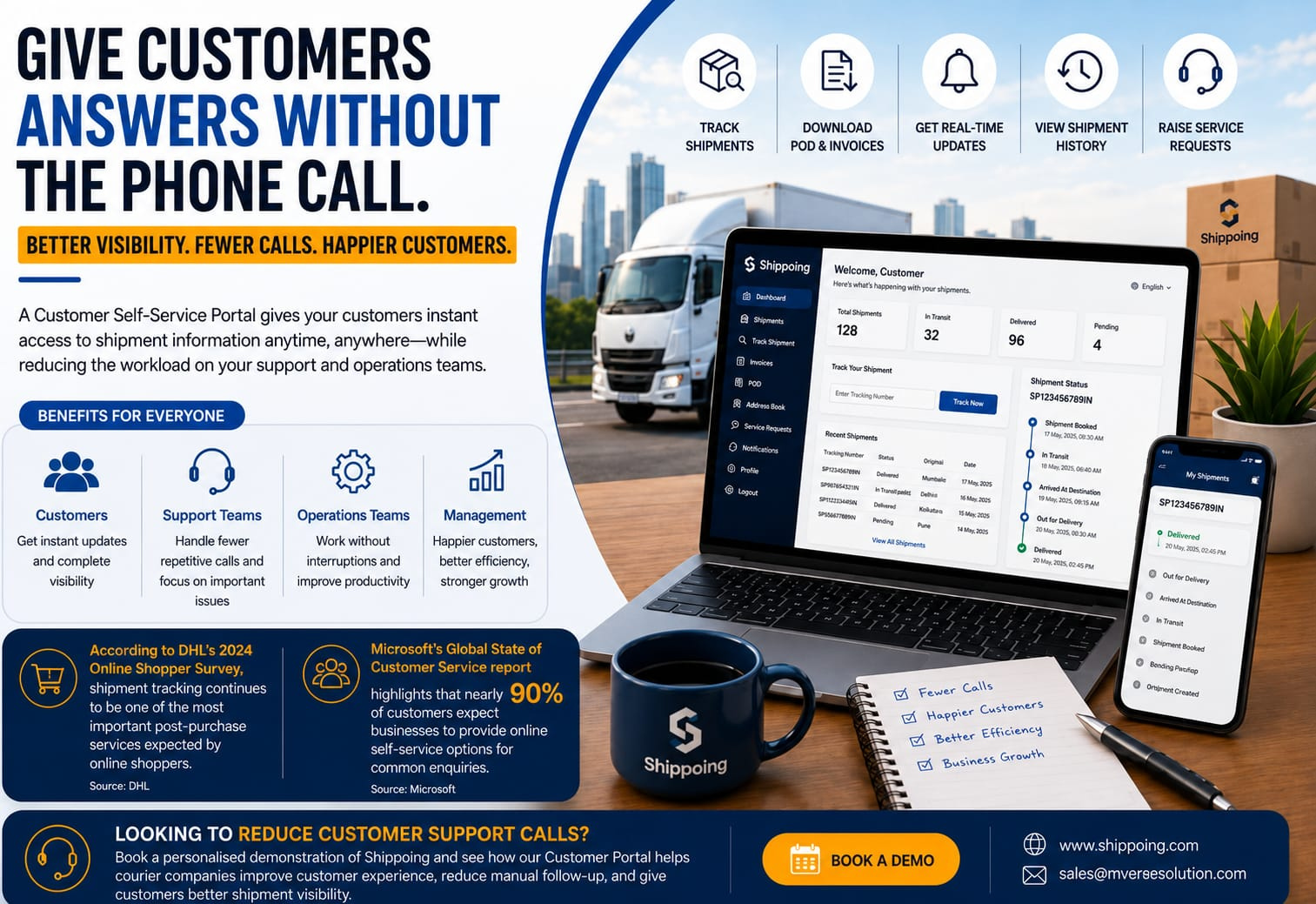
According to DHL’s 2024 Online Shopper Survey, shipment tracking continues to be one of the most important post-purchase services expected by online shoppers. Customers increasingly want visibility throughout the delivery journey rather than waiting for updates from customer support.
This is no longer an expectation only from large international courier companies. Customers expect the same level of visibility from regional and local courier companies as well.
The hidden cost of answering the same questions every day
Many courier companies never calculate how much time is spent answering routine customer enquiries. Think about a typical working day. Customers ask about shipment status. Customers ask for POD. Customers ask whether delivery has been completed. Customers ask for invoice copies. Customers ask for shipment history. None of these questions are unusual.
But when hundreds of customers ask the same questions every day, the support team’s entire day starts revolving around repeated follow-ups. Instead of solving customer problems, they spend most of their time providing information. Over time, this affects productivity across the entire organisation.
WhatsApp is useful, but it is not a long-term solution
Many courier companies use WhatsApp to communicate with customers. It is quick. It is familiar. It works well when shipment volume is low. But as the business grows, WhatsApp groups and individual chats become difficult to manage.
Important messages get buried. Different team members provide different information. Customers keep asking for updates. Support executives spend more time searching conversations than helping customers. WhatsApp is an excellent communication tool. But it should not become the primary system for managing customer enquiries.
What is a customer self-service portal?
A customer self-service portal is a secure online platform where customers can access shipment information themselves. Instead of calling customer support, they simply log in whenever they need information.
Customers can:
- Create shipment requests
- track shipments
- check current shipment status
- view shipment movement
- download POD
- access invoices
- view shipment history
- receive shipment notifications
- raise service requests
The information is available whenever they need it. No waiting. No repeated phone calls.
A customer portal benefits everyone
Many businesses think a customer portal is only for customers. Actually, everyone benefits.
Customers
Customers receive instant access to shipment information. They don’t need to wait for office hours. They don’t need to follow up repeatedly. They get better visibility and greater confidence.
Customer Support Team
Support executives spend far less time answering routine tracking questions. Instead, they can focus on solving delivery issues, customer complaints, and exceptional situations where human support is genuinely needed. A customer portal does not replace the customer support team. It allows them to spend their time where they add the most value.
Operations Team
Operations teams receive fewer interruptions throughout the day. Instead of constantly checking shipment status for customer enquiries, they can focus on managing deliveries, dispatch planning, branch coordination, and operational performance. This improves overall productivity.
Management
Management benefits because customer satisfaction improves without increasing support staff. The business becomes easier to manage as shipment volumes continue growing.
Better visibility builds customer confidence
The easier you make it for customers to find information themselves, the less they need to call your support team.
Customers become anxious when they don’t know where their shipment is. The lack of information creates uncertainty. Providing customers with better visibility reduces that uncertainty.
Customers can see:
- booking confirmation
- shipment movement
- hub arrival
- dispatch updates
- out-for-delivery status
- delivery confirmation
- POD availability
The more transparent the information is, the more confident customers feel. And trust is one of the biggest reasons customers continue doing business with the same courier company.
Think about your own experience while ordering something online. Most of us keep checking the tracking page until the parcel is delivered. Very few people actually want to call customer support. They simply want quick and reliable information. Courier customers are no different.
A customer portal also makes your business look more professional
Today, customers compare experiences across industries. They use banking apps. Food delivery apps. Cab booking apps. Online shopping websites. They expect the same convenience from courier companies. A customer portal creates that experience. It shows that your business is organised, transparent, and easy to work with. Sometimes, customer experience becomes a bigger differentiator than pricing.
What should a good customer portal offer?
A customer portal does not need hundreds of features. It should simply make life easier.
A good portal should allow customers to:
- Track shipments
- View current shipment status
- Download POD
- Access invoices
- View shipment history
- Download shipment documents
- Raise service requests
- Receive shipment notifications
- Manage multiple shipments
- Search shipments easily
The easier the portal is to use, the more customers will actually use it.
Common mistakes courier companies make
Many courier companies believe a customer portal is only useful for large organisations. That is not true. Even medium-sized courier companies handling a few hundred shipments every day receive a large number of customer enquiries. Another common mistake is waiting too long before introducing a customer portal. Businesses often wait until support teams become overloaded. By then, customer dissatisfaction has already started increasing. The right time to introduce a customer portal is before support becomes difficult to manage.
Customer expectations will continue to increase
The courier industry is becoming more competitive every year. Customers now expect faster communication, greater transparency, and better digital experiences. Microsoft’s Global State of Customer Service report highlights that nearly 90% of customers expect businesses to provide online self-service options for common enquiries. This expectation will only continue to grow. Courier companies that improve customer visibility today will be better prepared for tomorrow.
What to look for while selecting a customer port
If you are planning to introduce a customer portal, look for a solution that offers:
- Easy customer login
- Real-time shipment visibility
- Fast search
- Mobile-friendly access
- POD download
- Invoice access
- Secure customer information
- Automated notifications
- Integration with courier operations
The objective is simple. Reduce customer effort. Reduce support workload. Improve customer experience.
How solutions like Shippoing help
A good courier management platform should make life easier for both customers and internal teams. Shippoing has been designed around the day-to-day challenges faced by courier and express logistics companies. It combines shipment tracking, customer portal, POD access, notifications, billing information, and customer communication in one connected platform. The objective is not simply to provide another software screen.
The objective is to reduce manual follow-up, improve visibility, and help courier businesses provide a better customer experience.
Final thoughts
A customer self-service portal is no longer a luxury feature. As courier businesses grow, customer expectations also grow. People want quick answers. They want better visibility. They want information whenever they need it. At the same time, courier companies want to reduce support workload and improve operational efficiency. A well-designed customer portal helps achieve both. It gives customers the information they need while allowing your teams to focus on more important work.
In today’s courier business, better customer experience is not created by answering more phone calls. It is created by reducing the need for those phone calls in the first place.
Frequently Asked Questions
What is a customer self-service portal?
A customer self-service portal is an online platform where customers can independently access shipment information, track deliveries, download POD, view invoices, and monitor shipment history without contacting customer support.
Can small courier companies also benefit from a customer portal?
Yes. Even small and medium-sized courier companies receive repeated shipment enquiries every day. A customer portal helps reduce support workload while improving customer experience.
Does a customer portal replace the customer support team?
No. It reduces routine enquiries so that customer support teams can focus on solving important customer issues rather than answering repetitive tracking questions.
What information should customers be able to access?
Customers should be able to view shipment status, shipment history, delivery updates, POD, invoices, shipment documents, and service requests.
Is shipment tracking the same as a customer portal?
No. Shipment tracking is only one part of a customer portal. A customer portal provides a broader customer experience by combining tracking with documents, billing information, notifications, and customer services.
Looking to reduce customer support calls?
If your courier business is growing and your support team spends a large part of the day answering shipment status enquiries, it may be the right time to introduce a customer self-service portal.
Book a personalised demonstration of Shippoing and see how our Customer Portal helps courier companies reduce customer support calls, improve customer experience, and give customers better shipment visibility.