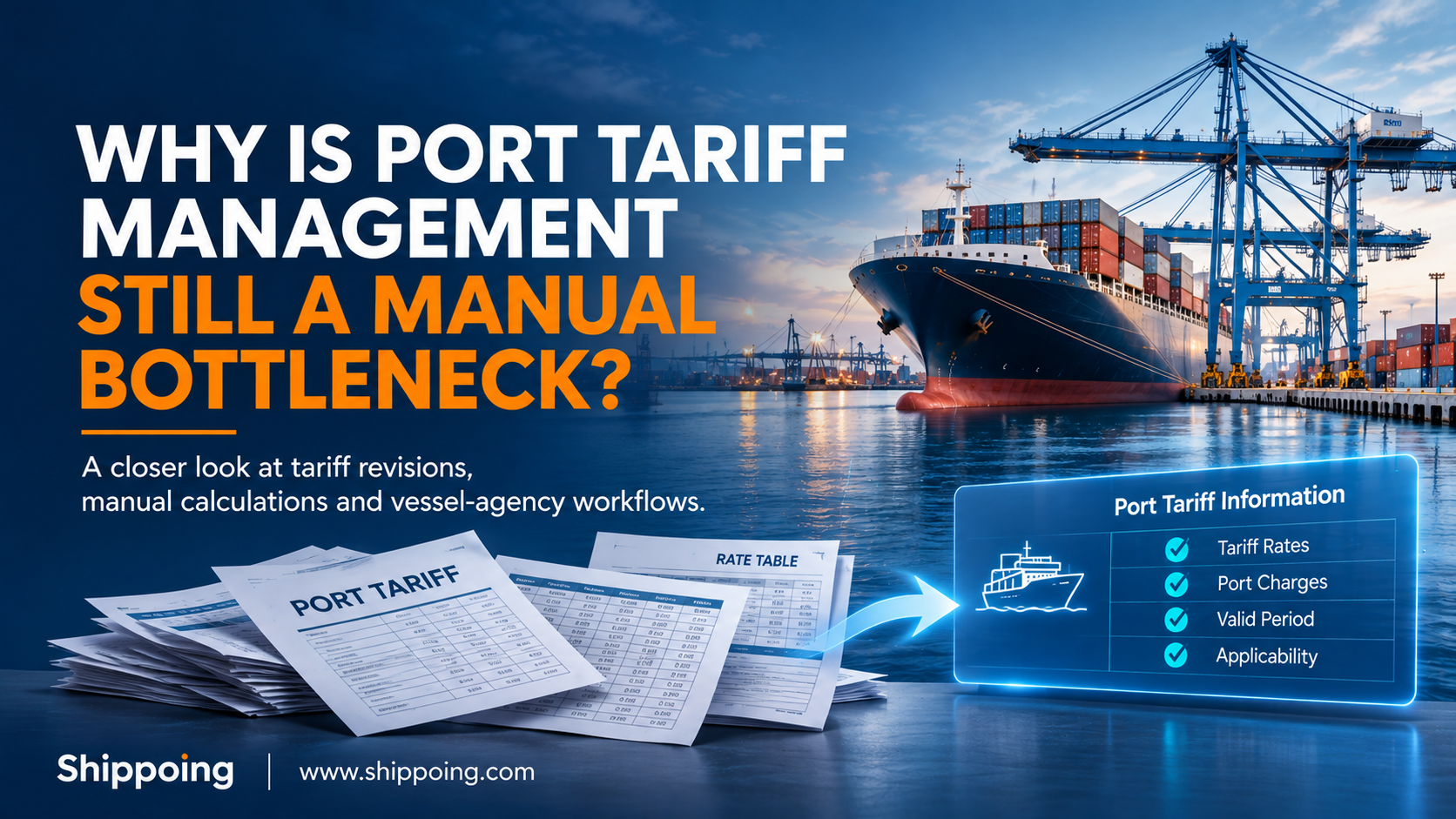
A tariff PDF is only the start of the work.
A vessel agent still has to work out which version applies, how to calculate the charge and whether the invoice matches what happened during the call. When the tariff circular is in an email, the estimate is in a spreadsheet and the service record is with operations, the team may have to reconstruct the same calculation twice: once before the vessel arrives and again after it sails.
Consider a coastal bulk carrier due to arrive at an Indian port on 29 June and sail on 30 June. The agent has already sent the principal a pro forma disbursement account (PDA), an estimate of the cost of the call. Then the port issues a tariff revision effective 1 July, and the vessel’s expected arrival moves to 2 July.
The port call, circular and INR amounts in this example are fictional. The amounts exclude taxes.
Which tariff applies?
The agent checks the circular against the existing Scale of Rates. In this example, the circular raises the combined pilotage and towage fee from ₹2,00,000 to ₹2,40,000 for the vessel’s tonnage band. The fee covers one inward and one outward movement. The circular says the revised fee applies to calls that begin on or after 1 July. The separate charge for a vessel-requested berth shift is unchanged.
The agent needs to check more than the new amount. The date the PDA was sent does not determine the rate: under this circular, the date the vessel enters port does. The reviewer also needs to know which movements the fee already covers. The Jawaharlal Nehru Port Authority’s 2026 Scale of Rates illustrates why: its pilotage and towage provisions distinguish shifts made for the port’s convenience from shifts requested by a vessel or terminal.
Revising the PDA
The agent confirms the vessel’s coastal status and checks its tonnage against the basis specified in the tariff. Operations confirms the planned movements: one inward and one outward, with no berth shift expected. The agent updates the pilotage and towage line to ₹2,40,000, an increase of ₹40,000, and sends the revised PDA to the principal.
The original estimate, the amended clause and the movement assumptions stay with the call record. When finance reviews the invoice, it can see exactly why the estimate changed.
Checking the invoice after departure
During the call, the vessel requests an unplanned shift to another berth. The movement record confirms that the shift took place, and the applicable tariff provides for a separate ₹40,000 charge. The agency now expects ₹2,80,000 for the combined fee and the shift.
The port invoices ₹3,20,000. Finance matches the invoice lines to the movement records and finds two shifting charges against the same reference. The port confirms the duplicate and issues a corrected invoice for ₹2,80,000.
The final disbursement account (FDA) is ₹40,000 above the revised PDA for these charges. The agency can explain the difference in one sentence: the vessel requested one additional berth shift. That extra service belongs in the final account; the duplicate does not. The FONASBA/BIMCO Agency Appointment Agreement distinguishes the estimated PDA from the final account and includes invoice checking among the agent’s duties under that agreement.
What could a better workflow save?
A 2012 study with Donnelly Tanker Management reported about 28% improvement in a timed PDA workflow pilot, based on ten runs. The pilot covered PDA preparation, document sharing and coordination between parties. The figure applies to that pilot; it does not isolate tariff work or measure PortWise performance.
Accuracy matters alongside speed. In a 2020 audit of Chennai Port’s operations system, India’s Comptroller and Auditor General found reduced tonnage values recorded in 36 of 2,172 vessel records marked as having no segregated ballast. The audit flagged inadequate controls over those entries. That is a useful reminder for any reviewer: even with the right tariff, the wrong vessel data can lead to the wrong charge.
To measure the opportunity in your own agency, compare staff time across similar calls. Count the time spent checking tariff revisions, updating estimates, matching invoices and resolving exceptions. Include time spent maintaining tariff records and verifying extracted data. Track waiting for supplier documents separately.
If your team measures a net saving of 15 minutes per call across 80 comparable calls a month, that gives back 20 staff hours a month. Use that as an illustration, then measure your own baseline. Alongside the time saved, check whether another reviewer can find the source clause, reproduce the charge and explain the invoice difference.
PortWise helps vessel agencies structure tariff information for review against the original source. Bring one tariff circular and an anonymised vessel call to a PortWise walkthrough. We can work through how your team checks the applicable charge and identify where it spends time repeating work.
Review your tariff workflow
Bring an anonymised tariff circular and one vessel call. We’ll walk through how your team checks the applicable rate, updates the PDA and explains any difference on the final invoice.
Request a 20-minute tariff workflow review.